Inputless Desmodus
Distributed legal intelligence (DLI): legal knowledge as a living graph—cases, themes, concepts, and authorities—reasoned and explored without the usual ask-and-wait analytics loop.
What is distributed legal intelligence?
Distributed legal intelligence is an approach to legal and pre-litigation reasoning where statutes, rules, cases, factual entities, and argumentative structure are represented together—as nodes and relationships in a graph—rather than as isolated documents or search results. Intelligence is "distributed" in the sense that relevance and linkage are modeled across the whole fabric of authorities and themes, not centralized in a single summary or dashboard.
The system surfaces how an argument theme connects to specific cases, how a focal matter ties to concepts and controlling rules, and how parties, judges, and citations sit in the same navigable structure. That makes precedent and procedural context inspectable as structure, not only as text.
Graph-native legal context
Themes, dockets, concepts, and citations appear as first-class relationships. You follow edges instead of re-running keyword searches for every new question.
Distributed over the knowledge fabric
Reasoning spans the network of authorities and entities. Updates propagate through the graph so local changes remain consistent with the wider legal model.
DLI in the terminal
Inputless Desmodus includes a terminal-oriented interface for exploring the legal graph—suited to secure environments, operator workflows, and sovereign deployments where a browser is not the primary surface.
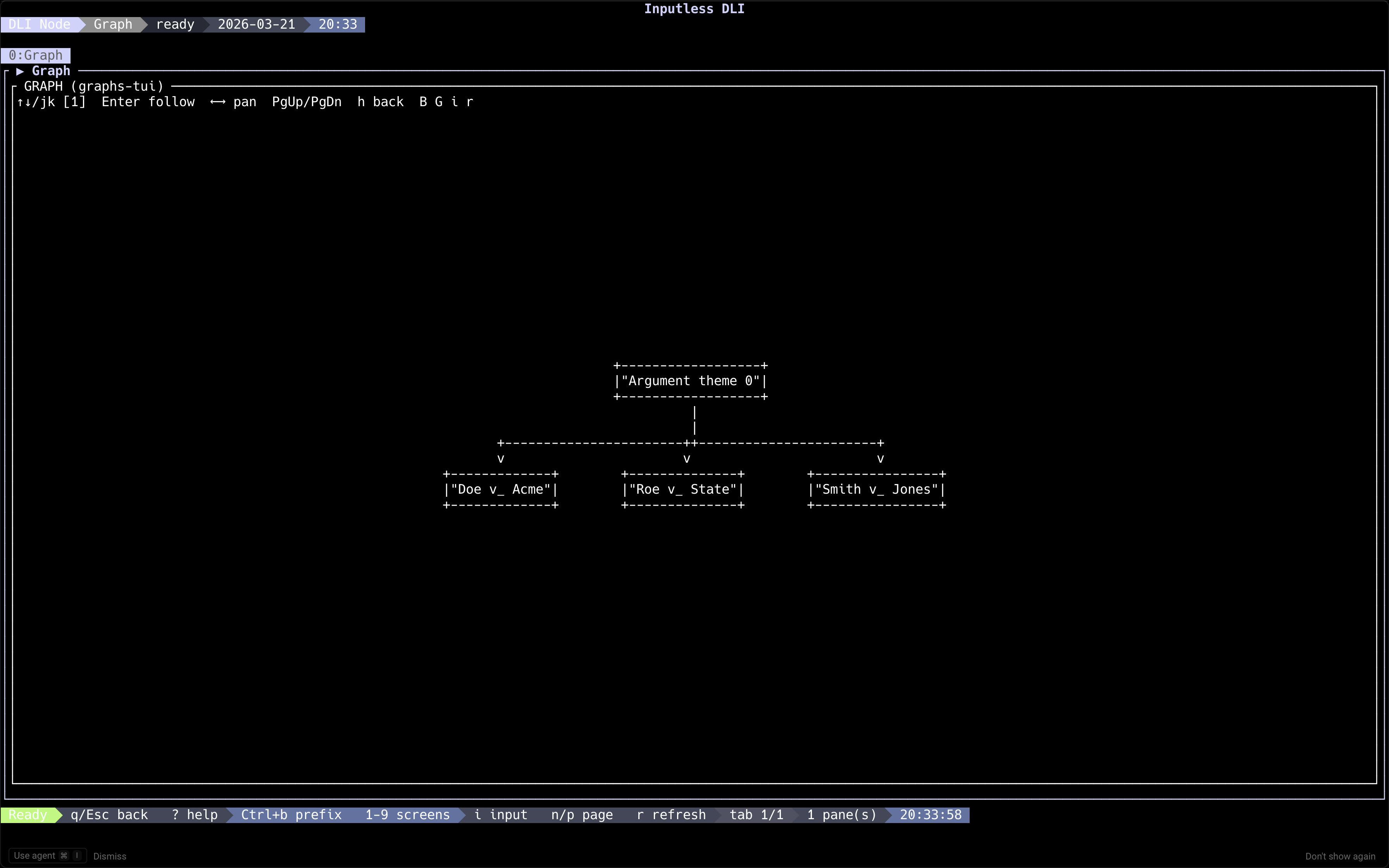
Argument themes connected to precedent cases in the DLI graph view—keyboard-navigable, terminal-native visualization.
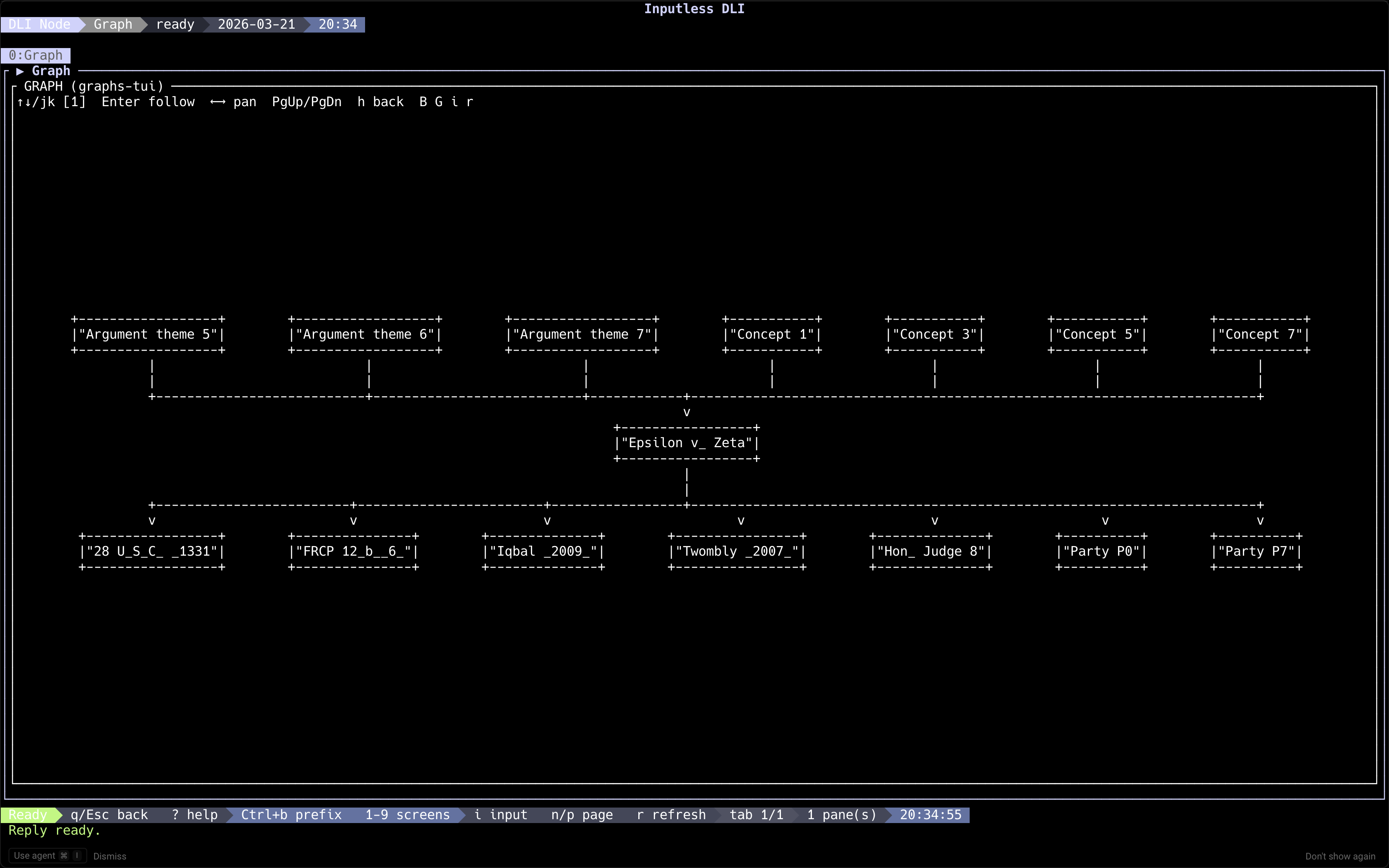
A focal case linked upward to argument themes and concepts, and downward to statutes (e.g. 28 U.S.C. 1331), rules (FRCP 12(b)(6)), landmark pleading cases, judges, and parties.